
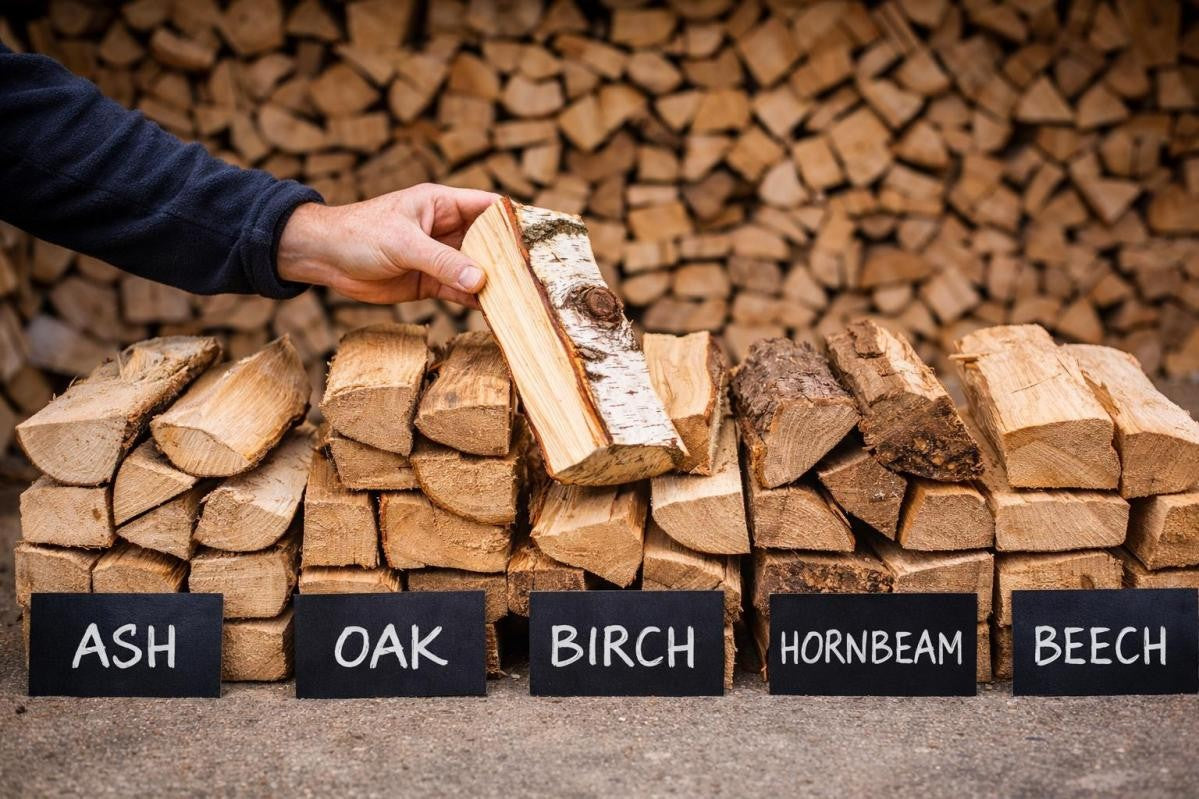
Canada is home to some of the largest forest areas in the world. From the maple forests of Ontario and Quebec to the towering Douglas firs of British Columbia, every region has its own mix of trees, and every type of wood has its own personality.
For many Canadians, firewood is more than just fuel. It is part of everyday life. Whether you are heating your home through a long winter, preparing firewood for a cottage, maintaining a rural property, or simply enjoying a wood-burning fireplace, knowing what kind of wood you are working with can make a big difference.
And if you regularly split your own firewood, there is another important question: What kind of log splitter is right for the wood in your area?
Let's take a closer look at some of Canada's major regions and the wood species commonly found there.

Ontario and Quebec: Where Hardwood Meets Cold Winters
If you live in Ontario or Quebec, chances are you have come across maple, oak, birch, or ash. These provinces have extensive mixed forests, with hardwoods playing an important role in the local firewood supply.
Maple is especially familiar to Canadian homeowners. Sugar maple and hard maple are dense hardwoods that burn well when properly seasoned. They are excellent choices for long-lasting heat, but their density can also make them more challenging to split, particularly when the logs are large.
Oak is another popular firewood choice. It is heavy, dense, and known for producing long-lasting heat. However, large oak rounds and pieces with knots or twisted grain can be difficult to split.
Birch is also widely used. It generally splits more easily than oak, although larger or knotty pieces can still put a log splitter to work.

For homeowners in these provinces, the right machine depends on the size and condition of the logs. A smaller splitter may be perfectly adequate for occasional household use, while people regularly processing large maple or oak rounds may benefit from a more powerful machine.
For everyday firewood preparation, the Forestwest BM11110S 12-ton log splitter is worth considering. If you regularly work with larger hardwood logs or want additional splitting capacity, the BM11097 18-ton electric log splitter offers another option. For heavier-duty applications, larger petrol models such as the BM11038 34-ton and BM11039 40-ton are available.
British Columbia: Big Trees and Plenty of Softwood

British Columbia has a very different forest landscape. Much of the province is covered by coniferous forests, and softwood species are especially common.
Douglas fir, western red cedar, hemlock, spruce, and pine are among the trees found throughout the province.
Douglas fir is a particularly interesting species. It is widely used in construction because of its strength and structural properties. It is also used as firewood, although its density and the presence of knots can make certain logs more challenging to split.
Western red cedar, on the other hand, is relatively lightweight and generally easier to split. Pine and spruce are also commonly used for firewood and are usually less demanding than dense hardwoods.
However, don't assume that all softwood is easy to split. A large Douglas fir round with heavy knots can be much harder to handle than a small piece of maple.
For BC homeowners who mainly split pine, spruce, or cedar for household use, a 10-ton or 12-ton splitter may be sufficient, depending on log dimensions. Those working with larger Douglas fir rounds or processing firewood regularly may prefer an 18-ton or heavier machine.
The key is to consider the actual size and condition of your logs rather than choosing a machine based on the tree species alone.
Alberta: Firewood for Farms, Rural Homes, and Winter Living

In Alberta, forests are particularly common in the northern part of the province and around the Rocky Mountains. Lodgepole pine, white spruce, black spruce, aspen, and balsam fir are among the species found in the region.
Pine and spruce are commonly used for heating and general firewood preparation. They are generally easier to split than dense hardwoods, making them suitable for many household log splitters.
Aspen is another familiar species. It is relatively soft and is usually easier to split, although larger rounds may still require a reasonable amount of force.
For people living on farms or rural properties, the amount of firewood needed can be just as important as the type of wood. Someone preparing a few loads of firewood for personal use has very different requirements from someone processing logs throughout the season.
A BM11110S 12-ton splitter can be a practical choice for regular household firewood preparation. If you have a larger property, process more wood, or frequently handle larger logs, moving up to an 18-ton or heavier model may make more sense.
Saskatchewan and Manitoba: A Mix of Prairie Life and Northern Forests

When people think of Saskatchewan and Manitoba, they often picture wide-open prairie landscapes. But travel further north, and you will find extensive forest regions.
These northern forests contain spruce, pine, aspen, birch, and poplar. Many rural households use firewood as a supplementary or primary source of heat, especially in areas where access to other heating options may be limited.
Aspen and poplar are relatively soft woods and are generally easier to split. Spruce and pine are also common choices for firewood.
For most homeowners working with smaller and medium-sized logs, a 10-ton or 12-ton splitter may be enough. If you are dealing with larger logs, knotty wood, or a higher volume of firewood, an 18-ton model provides additional capacity.
The important thing is to think about how much wood you actually process each year. Buying a larger machine than you need is not always the best investment.
Atlantic Canada: A Little Bit of Everything
New Brunswick, Nova Scotia, Prince Edward Island, and Newfoundland and Labrador have a mixture of hardwood and softwood forests.
Depending on where you live, you may regularly encounter red maple, sugar maple, yellow birch, beech, spruce, and balsam fir.
This variety means that firewood preparation can look quite different from one household to another.
Some homeowners mainly work with softwood, while others have access to dense hardwoods such as maple and beech. Many deal with a mixture of both.
If you are splitting a combination of hardwood and softwood, it is worth choosing a machine that gives you enough capacity for the more difficult logs you expect to encounter.
A 12-ton splitter may work well for ordinary household use, while an 18-ton model can be a better fit for people who regularly process larger or harder pieces of wood.
Understanding Wood Hardness: The Janka Scale
Not all firewood is created equal. Some Canadian wood species, such as Aspen and Poplar, are relatively soft and easier to split, while hardwoods like Oak, Hard Maple, and Beech require considerably more effort.
The Janka Hardness Test measures how resistant wood is to indentation. Although it does not directly measure how difficult a log is to split, it provides a useful way to compare the hardness of different wood species.
Below is a comparison of common Canadian firewood species and their Janka hardness ratings.

Log Splitter Capacity at a Glance
Choosing the right log splitter is not just about splitting force. The size of the logs you work with is equally important.
To help you compare different options, here is a quick look at the maximum log diameter and length supported by each Forestwest log splitter:
|
Splitting Force |
Power Type |
Max. Log Diameter |
Max. Log Length |
|
Electric |
12" |
16" |
|
|
Electric |
14" |
16" |
|
|
Petrol / Electric |
16" |
16" |
|
|
Electric |
20" |
28" |
|
|
Petrol |
24" |
28" |
|
|
Petrol |
24" |
26" |
Dimensions are rounded to the nearest inch and are based on the specified maximum log capacity for each model.
For smaller household firewood jobs, a 12-ton or 18-ton splitter may be sufficient. If you regularly work with larger logs, the 34-ton, or 40-ton models provide greater capacity for handling wider and longer pieces of wood.
Keep in mind that the maximum log dimensions are only part of the equation. Wood density, knots, grain direction, and moisture content can all affect how easily a log splits.
So, How Much Tonnage Do You Really Need?
One of the most common mistakes people make when shopping for a log splitter is assuming that more tonnage is always better.
While splitting force is important, it is only one part of the picture.
A small piece of straight-grained pine may split easily, even with a relatively modest machine. A large, twisted piece of oak with several knots may be much more challenging, even if it is not particularly long.
Before choosing a log splitter, think about three things:
The size of your logs. What is the average diameter? Do you occasionally deal with logs over 16 or 20 inches?
The type of wood. Are you mainly splitting pine and spruce, or do you regularly work with maple, oak, and birch?
How much firewood you prepare. Do you split a few logs on weekends, prepare enough wood for an entire winter, or process large quantities throughout the year?
For occasional household use, a 10-ton or 12-ton machine may be all you need. If you regularly handle larger hardwoods or process significant amounts of firewood, an 18-ton or heavier splitter may be a better investment.
Find the Right Log Splitter for Your Firewood
At Forestwest, we understand that not every homeowner has the same firewood needs. Someone in Ontario splitting large maple rounds may need a different machine from someone in British Columbia preparing pine and spruce for a cabin.
That is why choosing the right log splitter should start with understanding your wood, your workload, and your available power source.
Whether you are looking for a compact machine for occasional household use or a more powerful splitter for demanding jobs, Forestwest offers a range of log splitters to suit different needs.
Not sure which model is right for you? Tell us what kind of wood you split, the approximate log diameter, and how often you use your machine. Our team will be happy to help you find a suitable option.
Forestwest – Making Wood Processing Easier.